

Weekly Research Recap
Weekly report December 22, 2025 - January 4, 2026.

Weekly Recap Research
Institutional funds through the 2025 ETF also capture Bitcoin as its core, while Ethereum is gradually increasing its role in the portfolio.

The crypto ETF market in 2025 clearly reflects the direction of institutional investors' capital allocation, with Bitcoin spot ETFs continuing to dominate the top inflows, accounting for about 70— 85% of the total crypto ETF market throughout the year. Even at the end of the year, the daily trading volume slowed down, the proportion of Bitcoin holdings did not decrease significantly. Importantly, the image reflects a “slowing weight gain” behavior rather than downsizing, and indicates that Bitcoin is also viewed as a structural primary asset in the institution's long-term portfolio, rather than a short-term speculative asset.
Meanwhile, Ethereum spot ETFs are gradually starting to play an increasing role, with inflows in the range of around 15— 30% and likely to improve in the second half of the year. The expansion is in line with the listed company's ETH accumulation data, which clearly reflects the views of institutional investors who are beginning to separate the role of Ethereum from Bitcoin by looking at ETH. It is an asset linked to the blockchain economy and its potential for structural returns, while ETFs of other digital assets, despite being approved at the end of the year, continue to have a limited investment proportion, reflecting institutional caution towards assets that still exist. UNCERTAINTY, BOTH STRUCTURALLY AND REGULARIZED
Uniswap DAO Votes Through “Unification” Proposal,
Restructuring Protocol, Aiming to Link Revenue to UNI Token Value

The resolution was passed through the “Unification” proposal, a major restructuring of the protocol economy. Uniswap DAO approved the activation of a previously designed protocol fee switch, while requiring that a portion of the trading fees be applied to the process of buying back and burning UNI coins to reduce the circulating supply. Support from voters in a proportion higher than the clearly defined minimum, and after the end of the timelock period, $100 million of UNI coins will be burned from the treasury of the official protocol, which is designed to be a supply mechanism in Long term structural
The Unification approval also covers operational restructuring, with the integration of the Uniswap Foundation's role with Uniswap Labs to increase collaboration efficiency, along with fee reductions in products under Labs to support ecosystem expansion. Overall, the concept of Unification aims to link protocol usage directly to the value of UNI tokens, through fee and incineration mechanisms. Coin, which reflects a DeFi development direction that focuses on creating sustainable economic value for both token holders and long-term protocol users.
Top Net flows
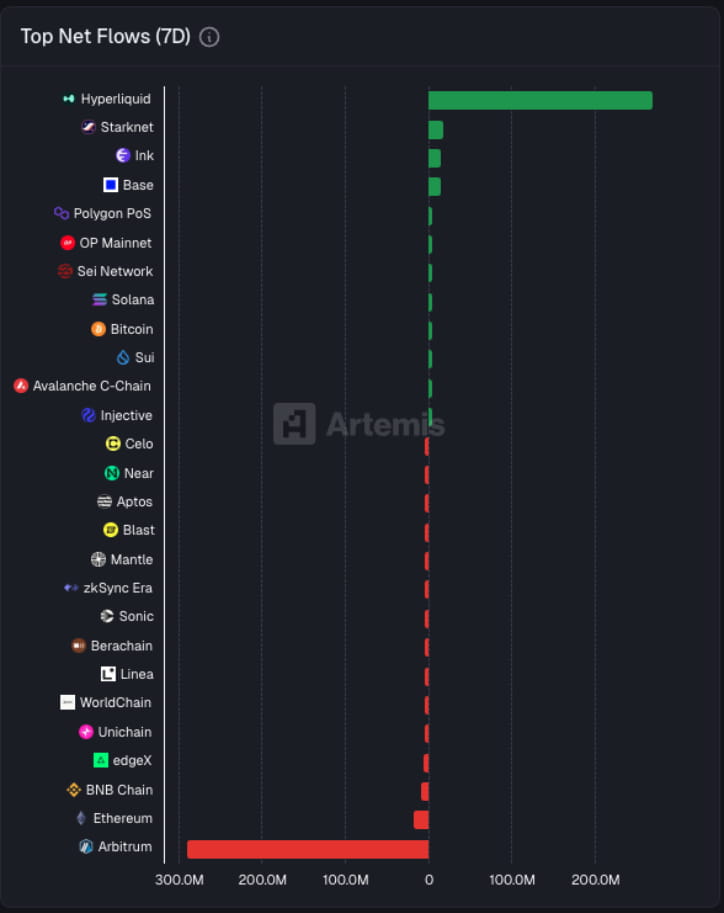
Over the past 7 days, Hyperliquid has clearly become the center of capital in the DeFi market, with a net inflow of over $250 million, the highest against any chain. Key factors come from the growing interest in the $HYPE coin coupled with the launch of the HyperEVM Mainnet, prompting investors to move capital in for speculation and preparedness. As for Airdrop, resulting in Hyperliquid being elevated to the hottest Narrative of the market during this period.
At the same time, Arbitrum appears to be the chain with the highest cash flow. However, the picture does not reflect a negative signal to the ecosystem, if it is more characterized by capital rotation. Since Arbitrum serves as the main route to bridge assets, especially USDC to Hyperliquid, it does not disappear from the market, but simply moves its position to the area that investors expect. Expect higher short-term returns
The overall picture from the graph reflects that the market is in a Risk-On state. Investors are starting to lose weight from highly stable mainchains like Ethereum or Arbitrum in pursuit of new opportunities or Alpha in the market. In addition to Hyperliquid, capital is also starting to see limited inflows into new chains like Ink and Starknet, reinforcing that the market is open to new Narrative and ready to take risks. Increase in this cycle
Fear & Greed Index
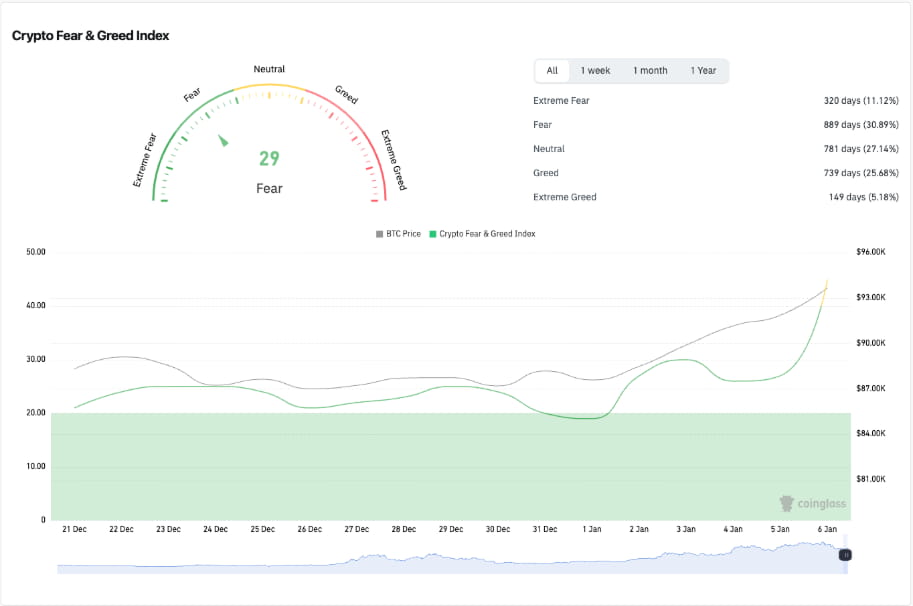
The Crypto Fear & Greed Index is one of the tools used to assess the outlook and sentiment of the crypto market, referring to scores ranging from 0 to 100 (0 stands for Extreme Fear or Extreme Fear and 100 stands for Extreme Greed).
During the period from December 22, 2025 to January 4, 2026, the crypto market was clearly under an atmosphere of paranoia, with the Crypto Fear & Greed index moving in a low range of around 18—30 points throughout the period. An interesting point lies in the New Year's confluence between December 31 and January 1, when the confidence level dropped into the zone. Fear of extremes” below 20 even if the price of core assets like Bitcoin will not weaken significantly, reflecting that market concerns in such a period are driven by sentiment and investment psychology rather than direct price changes.
The notable phenomenon occurred on January 4, 2026, when the price of Bitcoin surged past the $90,000 level, while the Sentiment Index weakened back to level 26, which remained in the Fear zone. This reflects the “Disbelief” view of investors who are not yet convinced that this round of recovery will continue and also see that a price increase may be possible. It is only a short-term rebound. As a result, the market has not yet experienced any speculation or repulsion from fear of a full-blown march.
The discrepancy between the adjusted price direction and the market sentiment that remains in a state of panic is an interesting structural reflection, as it indicates that the market has not yet entered overheating. A price recovery amid worries, or what is often referred to as the “Wall of Worry”, often creates a base that favors movement in the next phase rather than an upward move. Driven by the greed of a one-sided market
Bitcoin ETF Flow
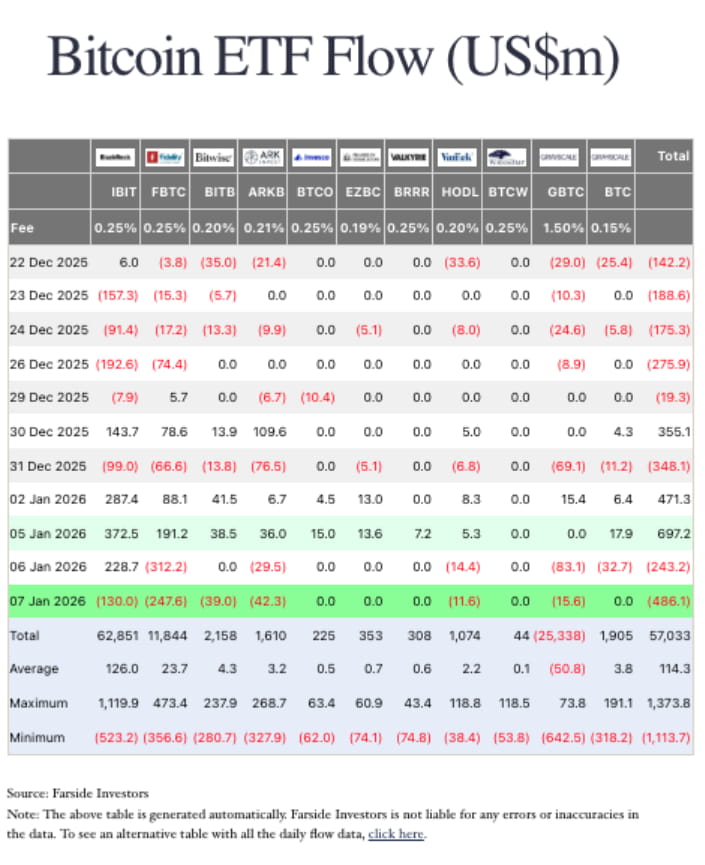
At the end of December 2025, the crypto market was clearly under pressure from the adjustment of the portfolio of institutional investors, especially on December 31, which saw up to $348.1 million in inflows from the Bitcoin ETF. Such a sell-off resulted in a rapid weakening of market sentiment. The Fear & Greed index fell into the “extreme fear zone. The “Extreme Fear” below 20 during the New Year's juncture reflects the uncertainty of retail investors, even if prices have not adjusted sharply in response to such pressures.
Entering the market open in 2026, the direction of capital flows has clearly reversed. On January 2, there was more than $471.3 million in net inflows in Bitcoin ETF. Institutional buying has become a key factor in the rapid recovery of the Bitcoin price and could rise above $90,000 in no time. The image indicates a sell-off in late. The former was simply managing the portfolio on a periodic basis rather than changing a negative view on the asset in the long run.
However, despite the strong price rally, the market sentiment index as of January 4 remained in the “Fear” zone at around 26—30 points. The discrepancy between the price recovery and the confidence level reflects the “disbelief” of retail investors who have not yet dared to buy, while investors chase. Institutions have accumulated before. Such a characteristic often appears at the beginning of a bullish market cycle, and reflects a gradually strengthening market structure rather than a patchy uptrend.
Ethereum ETF Flow
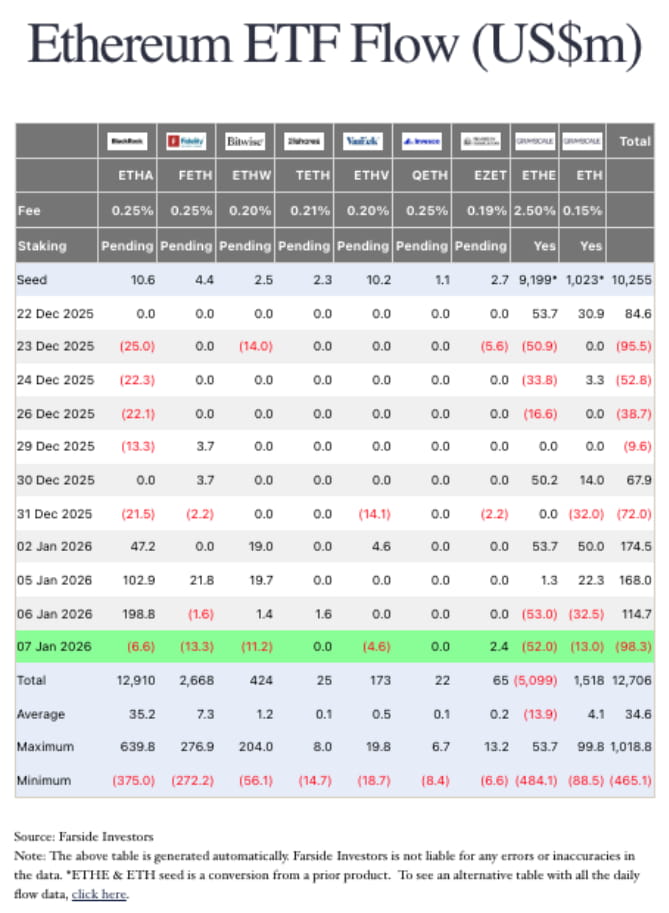
The cumulative sell-off at the end of the year has continued to put pressure on the Ethereum ETF in the final arc of 2025, especially during the 23—26 December period, where capital outflows were negative daily. Although December 30 started to see some buying power back in, by the end of December 31, institutional investors increased their sales force again, with a net outflow of around 72. Millions of dollars. The overview reflects risk-reduction behavior and portability adjustments to close the annual statements, rather than directly changing the negative outlook on Ethereum assets.
Stepping into 2026, the Ethereum ETF's capital flow direction clearly reversed as soon as the market opened, with net inflows reaching $174.5 million on January 2, almost twice as much as year-end outflows. The buybacks at that level reflect a return to institutional investors' investment weight, following restrictions around accounting and Finished budget management, along with an assessment of new investment opportunities at the beginning of the year.
The overview of movements during the New Year's Juncture reflects a clear pattern of Smart Money behavior, namely, a sell-off to adjust position at the end of the year, followed by a significant rebound in purchases on the first business day of the new year. A single day of inflows can almost completely offset the accumulated selling force in the previous period, suggesting that institutional investors' views on Ethereum in the next phase remain on the horizon. Positive rather than negative
Important news:
WSJ — U.S. STOCKS, S&P 500 INDEX ROSE, WHILE GOLD AND SILVER ROSE
Asian stocks are mixed as some markets close ahead of the new year.
Source:
https://www.theblock.co/post/384037/spot-bitcoin-etf-355-million-net-inflows
https://www.mexc.com/news/420306
Note: This analysis is provided every Monday, so some articles may have data discrepancies.
Nota: Questo analisi è situato ogni monday, quindi alcuni parti del articolo possono contengono informazioni inaccurati
WARNING: CRYPTOCURRENCIES AND DIGITAL TOKENS ARE HIGHLY RISKY. YOU MAY LOSE YOUR ENTIRE INVESTMENT. PLEASE STUDY AND INVEST ACCORDING TO THE ACCEPTABLE LEVEL OF RISK.
Thank you for following.
J.P. Daniel
News Cryptocurrency

%20(1).avif)
.avif)
Download the Maxbit application at


Securely register with a digital asset trading platform regulated by Thailand’s SEC.


Maxbit Digital Asset Co., Ltd., 90 CW Tower, 31st Floor, Room A3101-02, Ratchadaphisek Road, Huai Khwang Subdistrict, Huai Khwang District, Bangkok 10310, Thailand.
©2025 Maxbit. All Rights Reserved.


