
Weekly Recap Research 27 Oct - 02 Nov 2025
For the week of October 27 - November 2, 2022
_progressive.jpg)
Weekly Recap Research
Trade relations between the U.S. and China are back on track after the two countries agreed to cut tariffs and increase trade between them.

President Donald Trump reached a landmark trade deal between the United States and China on October 30 in Busan, South Korea, with President Xi Jinping to ease tensions between the world's two largest economies. The deal marks a major step in de-escalating the conflict. According to an official White House factsheet, the agreement includes a number of key points from the Chinese side, including the termination of new export control measures for rare and essential minerals, the suspension of the influx of fentanyl substrate into the United States, the abolition of tariffs. All retaliatory and non-tariff measures in effect from March 4, 2025, include a guarantee from China to import at least 12 million metric tons of soybeans from the United States by the end of this year, and an increase in import volumes to at least 25 million metric tons per year in a row until 2028.
The United States announced a 10% reduction in tariffs on imports from China effective November 10, 2025, and extended its Section 301 tariff exclusions for another year. It also suspended U.S.-China trade retaliatory measures related to investigations in the shipping and logistics sectors. Which is also under way to ease trade tensions between the two countries in the short term.
The historic trade deal has significantly restructured relations between the U.S. and China, ending a cycle of retaliatory measures that had previously undermined sector profits and created uncertainty for supply chains in key industries. The direct beneficiaries of the agreement include the U.S. agricultural sector, the semiconductor industry and mineral production. Critical minerals for electric cars and consumer electronics, analysts see risky assets such as equities, technology stocks and digital assets could be buoyed by a return of confidence following regulatory and regulatory uncertainty. Trade declines. The recent slowdown in crypto markets may see an increase in institutional capital inflows, while improved trade relations between the two countries could facilitate the cross-border operations of crypto companies in the US and help mitigate the volatility caused by market news.
Aster soars after CZ reveals stake worth over $2.5 million

ASTER tokens surged nearly 20% after Binance founder Changpeng Zhao (CZ) acquired $2 million worth of tokens, sparking a wave of interest and speculation in the market. The project behind ASTER is a rebranded derivative platform, combining older tokens and launching them again. Token Creation (TGE) in September 2025
ASTER has a maximum supply of 8 billion tokens, with more than half allocated for community incentives, both in the form of airdrops and strategic distribution. The platform defines itself as a hybrid decentralized trading board (Hybrid DEX) that supports trading on both Perpetual and Spot contracts on multiple. Blockchain with features such as hidden orders and high leverage
The overt endorsement by CZ is a key factor in the breakeven point for ASTER's price to skyrocket. On-chain data cited by analysts reveals that ASTER's wallet has accumulated a large amount of USDT, making it one of the largest wallets on the BNB Chain network after Binance itself. However, even if the price rally is real, the risk of a correction remains high, as A large supply of tokens, intense competition from competitors like HYPE, as well as price rises driven by currents and narratives rather than clear and sustained fundamentals, have also contributed to this situation. MUST BE CLOSELY MONITORED FROM THE INVESTOR SIDE.
Top Net flows
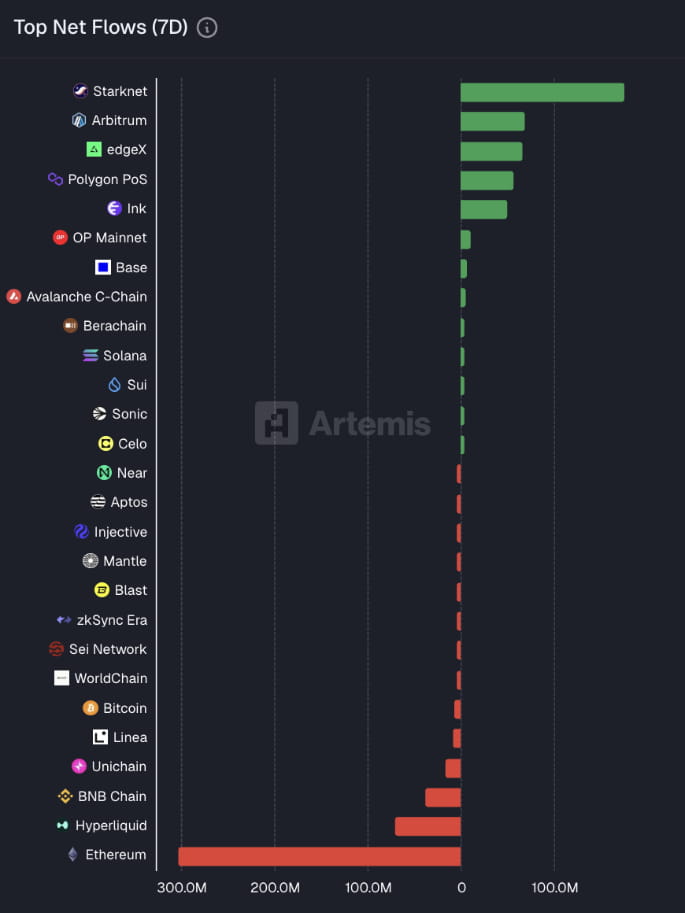
The latest data clearly echoes the crypto market's key signals that liquidity is moving from mainstream networks like Ethereum to Layer 2 and emerging blockchains like Starknet, Arbitrum and EdgeX this week, with Starknet becoming the network with the highest net inflow on the market at $176 million. The show reflects the growing interest in Cairo technology. VM, the growth of the DeFi ecosystem and the anticipation of the Incentive program to be launched in the future, followed by Arbitrum, with a net inflow of around $68.5 million. It continues to be the center of major DeFi activities such as GMX, Radiate, Pendle, and Yield protocols. Various farming that continues to be strong, the EdgeX and Polygon PoS segments also have a dominant inflow, given the popularity of users who want a high-yield network and lower fees than Ethereum.
Ethereum, on the other hand, returned to its highest net outflows in a week over $303 million, which may reflect the asset's move to Layer 2 to join a new reward or more rewarding DeFi program. Meanwhile, BNB Chain, Hyperliquid, Unichain and Linea have continued to flow, especially Hyperliquid, which used to be popular with futures trading but starting to burn. Faced with lower yields in the latter
Fear & Greed Index
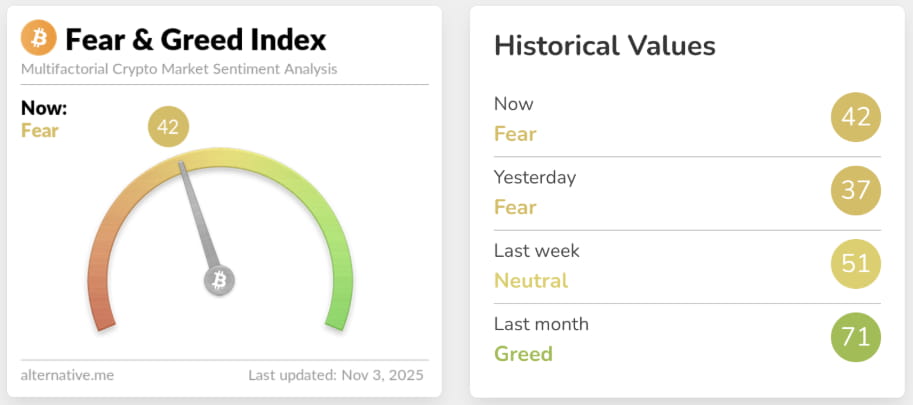
The Crypto Fear & Greed Index of the website alternative.me is one of the tools used to assess the outlook and mood of the crypto market, citing scores ranging from 0 to 100 (0 means extreme fear or Extreme Fear and 100 means extreme greed or Extreme Greed).
The Fear & Greed Index fell to 42 points in the “fear” zone after a month before the market was still in a “greed” state with the index reaching 71 points. The current situation reflects an atmosphere of “rational fear” after a period of investor confidence. Too much in recent months, many investors are in the process of adjusting their portfolios and waiting for clarity on Bitcoin's price direction as well as the global economic outlook. The crypto market continues to face uncertainty from a variety of factors, including the global economy, legal rumors, international politics, and the movements of major holders, when taken together. With Netflow data on various networks, the fact that the Fear & Greed index is at 42 points may reflect that the market is in a “base pause” before entering the crucial decision point of a new cycle in the crypto market.
Bitcoin ETF Flow
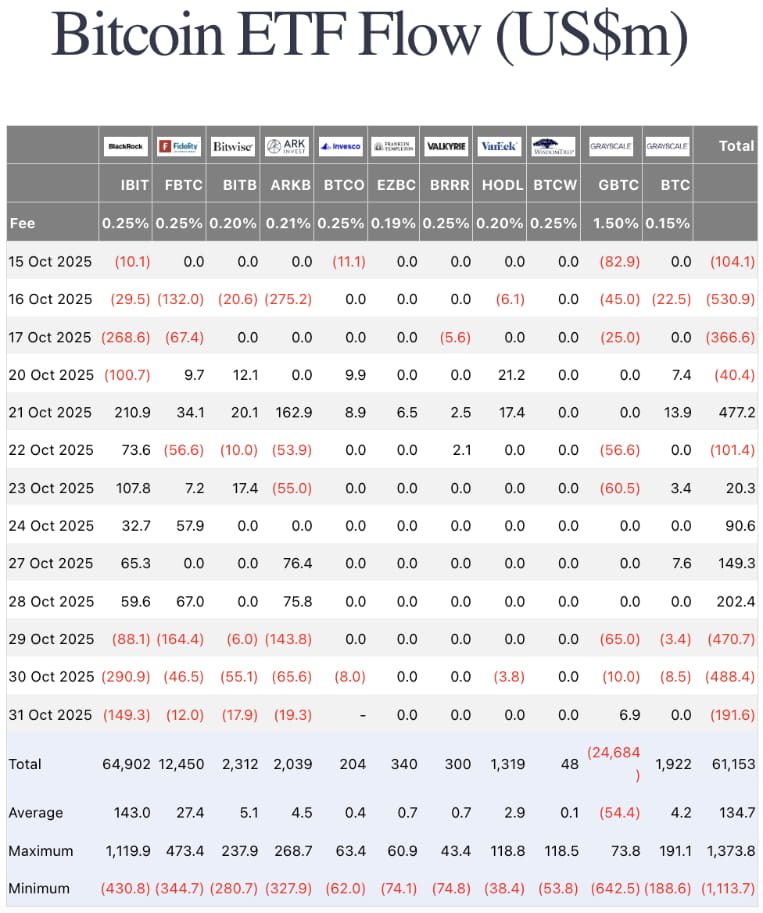
During the last week of the month, the Bitcoin ETF experienced another high volatility, with the 27—28 October having strong net inflows from the previous week, on October 27, at around $149.3 million, and on October 28, around $202.4 million. However, from October 29—31, the market resumed selling, led by outflows from the pile. Core funds such as IBIT, FBTC and ARKB as of October 29 had net outflows of about $470.7 million, on October 30 about $488.4 million, and October 31, about $191.6 million. These data reflect the profitable sales force of institutional investors before the end of the month, including Portfolio Rebalancing
Ethereum ETF Flow
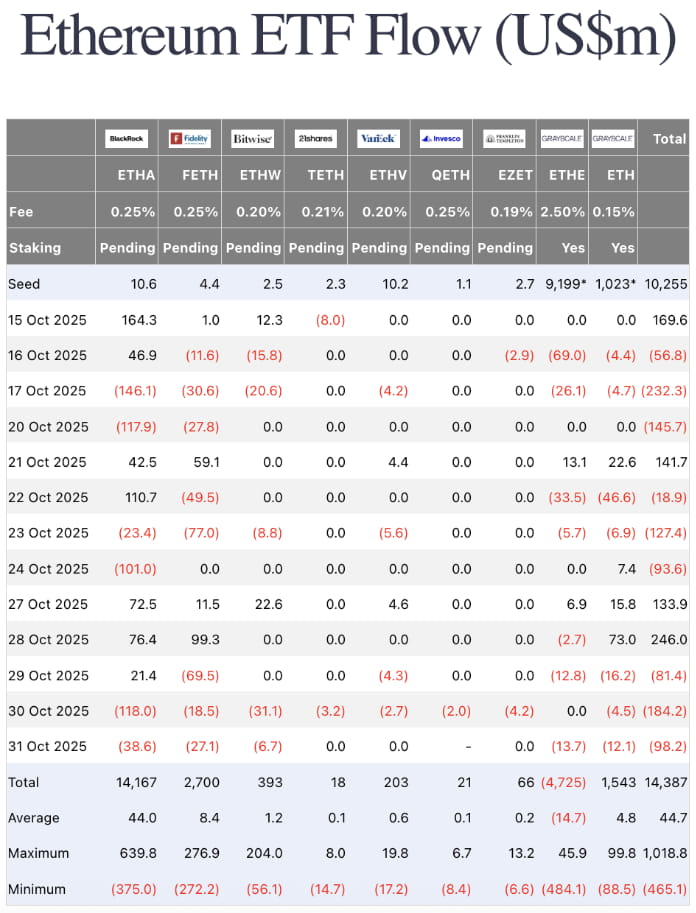
The last week of October 2025 clearly shows a shift in liquidity in the Ethereum ETF market, from buying back forces that supported prices at the beginning of the week to a profit selling force at the end of the month. On October 27, there was a net inflow of about $133.9 million and on October 28, around $246 million, but on the other hand, on October 29, there was a return of cash flow. Net issues were around $81.4 million on October 30, around $184.2 million, and on October 31, about $98.2 million. These data reflect the short-term turnover behavior of institutional investors, but do not dampen long-term sentiment if the late-month sell-off is merely a correction. Normal portfolios have a high chance of a renewed buy-back in early November, especially in large funds such as BlackRock and Fidelity, which also hold huge capital stakes.
Important news:
A Nordic bank that once rejected crypto is about to offer a Bitcoin ETP
Cryptocurrency CEO Dies in Turkish Jail as Victims' Lawyers Call for Probe
How does Tether make $1 trillion in 2025, compete with big banks
Source:
https://cryptoslate.com/us-china-trade-deal-marks-the-biggest-de-escalation-yet-for-global-markets
https://www.coindesk.com/markets/2025/11/02/aster-zooms-20-as-binance-s-cz-purchases-2m-tokens
Note: This analysis is provided every Monday, so some articles may have data discrepancies.
WARNING: CRYPTOCURRENCIES AND DIGITAL TOKENS ARE HIGHLY RISKY. YOU MAY LOSE YOUR ENTIRE INVESTMENT. PLEASE STUDY AND INVEST ACCORDING TO THE ACCEPTABLE LEVEL OF RISK.
Thank you for following.
Thanakarn
News Cryptocurrency
_progressive.jpg)
_progressive.jpg)
_progressive.jpg)
Download the application Maxbit is available at


Securely register with a digital asset trading platform regulated by Thailand’s SEC.


Maxbit Digital Asset Co., Ltd., 90 CW Tower, 31st Floor, Room A3101-02, Ratchadaphisek Road, Huai Khwang Subdistrict, Huai Khwang District, Bangkok 10310, Thailand.
©2025 Maxbit. All Rights Reserved.


