

Weekly Recap Research 17 - 23 Nov 2025
Week of November 17 - 23, 2022
_progressive.jpg)
Weekly Recap Research
ARK Invest Buys Market's Crypto Stocks to Catch Bullish Bullish Momentum
ARK Invest moved to buy shares in a large crypto business in the past week. Even as both the stock and digital asset markets are facing heavy pressure. Shares of several crypto companies closed noticeably negative, Cathie Wood's fund opted to buy more, investing more than $10 million to buy Coinbase shares, one of the critical infrastructure of the crypto market. It also acquired about $9.9 million worth of BitMine stock, including shares of Circle, a major stablecoin issuer, and nearly $9.65 million in shares of crypto trading platform Bullish.
All the moves came at a time when the stock prices of these companies were weakening, Coinbase plunged more than 7% in a single day, while BitMine plunged more than 10% and Circle weakened, albeit to a lesser extent. However, ARK looks back on this as a cumulative buying opportunity, reflecting that the fund still believes in the fundamentals of the crypto industry and sees short-term volatility as not a factor in the bug. Undermines the long-term trend of the market.
The buying momentum signals an important signal at a time when many retail investors are opting to sell due to ARK concerns, as if this adjustment to the base is seen as an opportunity to accumulate crypto-related assets in a low price range. These data also reflect that some institutions have not changed their view of the structural growth of the crypto ecosystem, despite the market volatility or presence. Even though the news is constantly being removed
The event reinforces that the crypto market is still an area where many are “fearful, but some are still daring,” and when global funds continue to buy on a bearish day, it's yet another sign that the fundamentals of the industry remain, just waiting for a new recovery rhythm along the financial market's original cycle.
Bitcoin Miner Shares Rebound After Nvidia Shows Brutal Q3 Report

Nvidia's Q3 results became a major impetus for shares of several Bitcoin mining companies to rebound immediately after the market close. Despite the relatively sluggish state of the crypto market over the period, Nvidia's massive $57 billion in revenue, including a Q4 forecast valued between $63.7—66.3 billion, generated positive momentum for related stocks. With the crypto mining industry, as GPU demand continues to grow due to the AI sector, the market sees that businesses using similar infrastructure could see positive results as a result.
As soon as the report was published, shares of Cipher Mining jumped more than 13% in the post-market period, while IREN moved around 10%, although the price of bitcoin was not the main supporting factor. Such a response was not just a psychological expectation of investors, but the fact that many mining companies began to “expand their business models.” Towards more AI and High-Performance Computing infrastructure services, IREN recently signed a major AI contract with major customers. Cipher closed an AI hosting deal with another cloud provider, reflecting the mining industry's transition from traditional to traditional. A new role that leverages the power of computing power to meet the demands of the ever-growing AI world
The link between the two industries has caused mining company stocks to react sharply to Nvidia's earnings because, from a market perspective, if Nvidia grows on surging demand for AI processing, businesses that hold high levels of computing power and can serve this field, such as mining companies, have the opportunity to grow. The trend reflects the significant shift in the Bitcoin mining industry that Want to monetize from a new source instead of relying on a single Bitcoin factor
The whole picture therefore reflects that mining companies are shifting their role from a player in the digital asset market to an infrastructure provider for artificial intelligence, and the market seems to be strongly receptive to this new direction. If Nvidia continues to make a remarkable contribution, the link between the two industries could become even stronger, until the line between the “Bitcoin miners”. AND “AI PROCESSING POWER PROVIDERS” COULD FADE DRAMATICALLY IN THE COMING YEARS.
Top Net flows
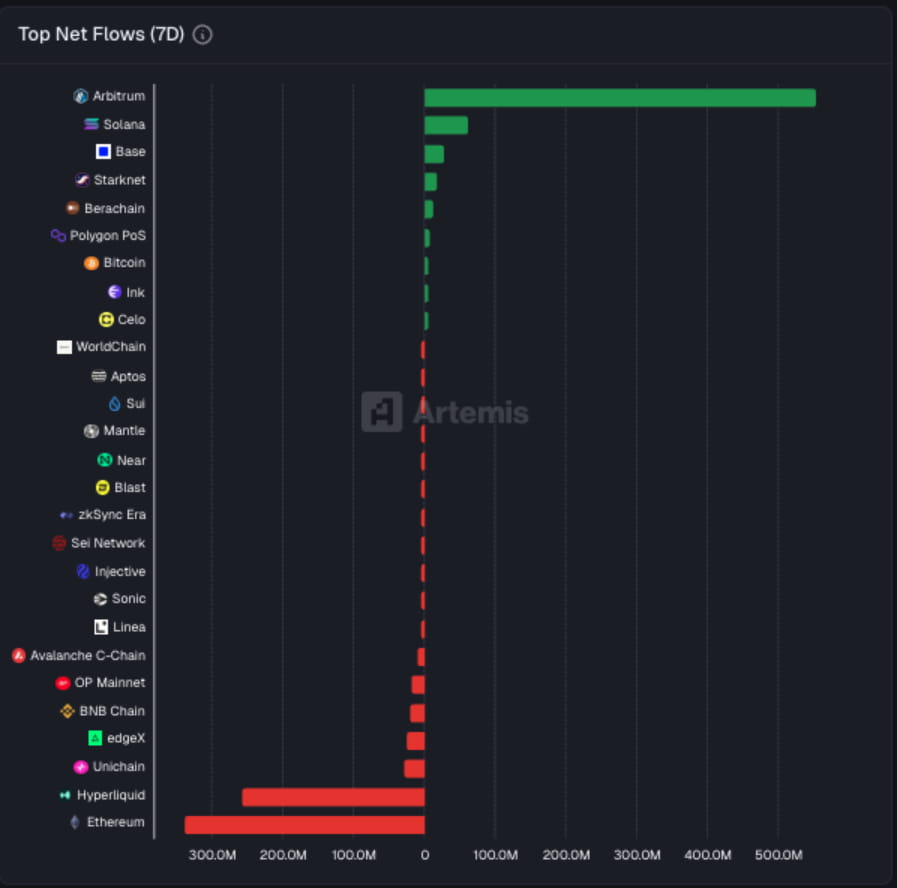
The Netflow data of the various networks between November 17—23, 2025 clearly reflects the direction of the movement of capital in the crypto market, with Arbitrum being the most prominent network, with inflows of up to $553.5 million, while Solana and Base, despite the inflows of capital as well, are lagging behind. On the contrary, many of the leading networks. Revenues are facing outflows: Hyperliquid, Unicchain, BNB Chain, OP Mainnet, and the heaviest is Ethereum, which has the most negative Netflow of all networks.
The outlook reflects investor sentiment is spinning in a clearer direction. Arbitrum has been buoyed by continued growth in ecosystem activity, an increase in TVL, and cost and performance advantages that continue to draw in liquidity. The Solana side, which followed in second place, has been buoyed by the influx of DeFi and memotokens on the chain. Still buoyant, the Base segment continues to maintain steady inflows from a high daily user base, and incoming social and DeFi protocols continue to increase, even though the numbers aren't as striking as Arbitrum.
Ethereum, on the other hand, continues to face liquidity outflows due to higher transaction costs than Layer 2 and user behavior that tends to move to faster and cheaper chains. While this movement is not a new phenomenon, this Netflow series makes it clear that large capital flows are moving away structurally rather than short-term port swapping on the Hyper-side. Liquid, with a heavily negative Netflow, echoed the pullout from derivatives players adjusting their portfolios to market conditions, while BNB Chain and OP Mainnet both faced outflows in the same direction, as if losing interest to chains with a stronger narrative during the week.
Looking at the whole picture, this week's Netflow clearly reflects that the big bullion is spinning away from older L1 and slower growing networks into Layer 2 with continued growth in practicality. Such a trait is akin to a move of capital to invest in a new set of market infrastructure and could be the start of a new round of trends towards the end of the year. If this trend continues, Arbitrum has a chance. Stepping up as the epicenter of liquidity continues, as networks facing outflows like Ethereum may rely on new activities such as staking, restaking or additional technology solutions to recapture attention and capital.
Fear & Greed Index
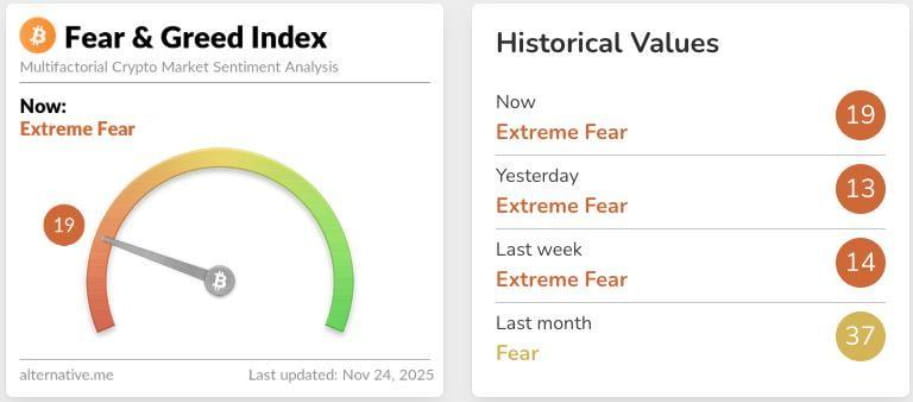
The Crypto Fear & Greed Index of the website alternative.me is one of the tools used to assess the outlook and mood of the crypto market, citing scores ranging from 0 to 100 (0 means extreme fear or Extreme Fear and 100 means extreme greed or Extreme Greed).
The Fear & Greed Index of the crypto market on November 24, 2025 stands at 19 points, which is in the Extreme Fear zone, reflecting the atmosphere of concern that envelops the market and the level of risk perceived by investors is sharply increasing.
Retrospective data also reinforced the same picture. Yesterday the index was 13th and the week before it was 14th, all in the Extreme Fear level for several consecutive days, while the previous month the index was at 37, which is also a normal Fear level. It shows that the market is gradually moving into more tension until it reaches the level of intense fear in the current range.
Bitcoin ETF Flow
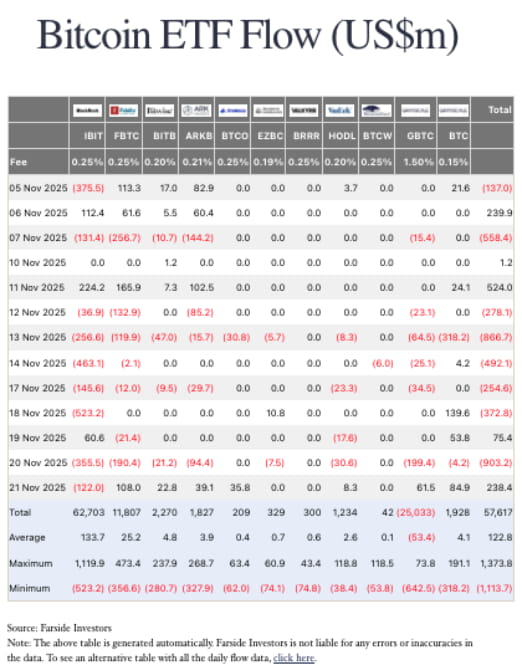
Bitcoin ETF cash flows between November 17—21, 2025 were volatile throughout the week, beginning with a massive sell-off at the beginning of the week, before periodically alternating positive flows. November 17 opened with a total outflow of over $254.6 million, followed by November 18. As the sell-off intensified, the total negative figure increased to more than $372.8 million, reflecting that pressure from large funds has not eased much.
On November 19, buying momentum started to calm the market, with the aggregate cash flow figure turning positive at around $75.4 million, after being mainly driven by the inflow of IBIT funds. Although other funds continued to sell regularly, the buying back was enough to revive the overall picture of the ETF market. Temporary rise
However, the positive signal came only briefly because November 20th turned out to be the heaviest day of the week, with total outflows of over $903.2 million, the highest level of November. This ripple force was driven by the simultaneous sell-off of several major funds, from IBIT, FBTC, BITB to GBTC with almost two outflows. Hundreds of millions of dollars resulted in a markedly pressured ETF market overview.
The week ended on November 21, when the numbers returned to positive again at $238.4 million, thanks to simultaneous inflows from multiple funds, giving the market a late-week recovery momentum after facing several consecutive days of volatility earlier.
Taking into account the overview of the period of November 17—21, it can be seen that this week was filled with significant fluctuations in capital flows, with two days of strong inflows, two days of clear inflows, and another day of slightly positive numbers, making it one of the weeks when the Bitcoin ETF market has a “heavy early—middle—good ending pattern.” Most clearly in November.
Ethereum ETF Flow
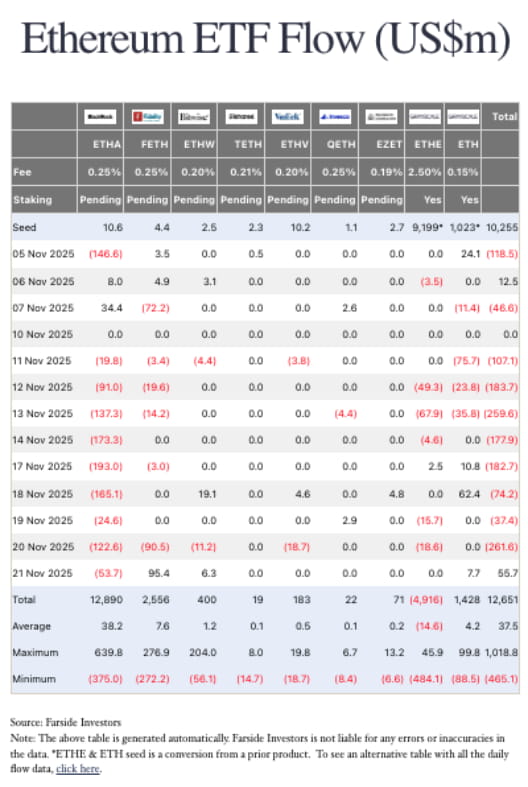
Ethereum ETF cash flows between November 17—21, 2025 were in negative motion almost throughout the week, with the numbers reflecting that funds continued to flow out of ETH funds. Many funds recorded negative cash flows almost daily, making this period one of the weakest aggregate cash flow weeks of the month.
November 17 began with over $182.7 million in cash outflows from simultaneous sales across multiple funds, including ETHA, FETH, ETHW, and Pending funds, all in negative territory. Later on November 18, the sell-off continued, with outflows rising to $204.2 million, although some funds did not budge. Count the numbers, but the hundreds of millions of dollars' worth of negative balances from large funds remain outstanding.
November 19 was still a negative day, including $47.2 million. Despite a decrease from the previous day, it reflected that capital flows had not significantly flowed back into Ethereum's ETF products, while on November 20, outflows increased to $261.6 million on the outflows of large funds such as ETHA and FETH. Simultaneously, resulting in one of the highest sales force days of the month.
The final stretch of the week on November 21, despite the absence of large inflows, the total cash flow remained negative at $52.7 million, closing the week with several consecutive days of capital outflows, without a date at all positive in the numbers.
At the end of the week, November 21, there was still no clear buying back, with negative total cash flow of $52.7 million, closing the week with five consecutive negative numbers, with no positive day at all.
Considering the entire period of November 17—21, it can be seen that the Ethereum ETF market faced daily outflows, with daily sales ranging from tens of millions to hundreds of millions of dollars, making this period seen as one of the weakest Ethereum ETF inflows of November.
Important news:
Offchain Labs Reacts to Vitalik Buterin's RISC-V Proposal, Opts for WASM on Ethereum L1 Instead
Source:
https://defillama.com/chain/arbitrum
https://defillama.com/chain/solana?tvl=true&chainRevenue=false
https://dappradar.com/rankings/protocol/solana/category/defi
https://blockworks.com/analytics/base
Note: This analysis is provided every Monday, so some articles may have data discrepancies.
WARNING: CRYPTOCURRENCIES AND DIGITAL TOKENS ARE HIGHLY RISKY. YOU MAY LOSE YOUR ENTIRE INVESTMENT. PLEASE STUDY AND INVEST ACCORDING TO THE ACCEPTABLE LEVEL OF RISK.
Thank you for following.
JP. Daniel
News Cryptocurrency
_progressive.jpg)
_progressive.jpg)
_progressive.jpg)
Download the application Maxbit is available at


Securely register with a digital asset trading platform regulated by Thailand’s SEC.


Maxbit Digital Asset Co., Ltd., 90 CW Tower, 31st Floor, Room A3101-02, Ratchadaphisek Road, Huai Khwang Subdistrict, Huai Khwang District, Bangkok 10310, Thailand.
©2025 Maxbit. All Rights Reserved.


