

Weekly Research Recap 12 - 18 Jan 2026
Week of January 12 - 18, 2026
_progressive.jpg)
Weekly Recap Research
Kraken Indicates 2026 Crypto Market Will Change From”viral” Towards a real structure, driven by institutions and macro factors
According to Kraken, 2026 could be an important transition period for the crypto market, from an era driven primarily by speculation, to a state of greater emphasis on “market structure.” In particular, the role of Bitcoin ETFs and stablecoin liquidity are beginning to have a direct influence on pricing and market direction. Estimates suggest that cash flows from Spot Bitcoin ETFs. In 2025, the inflows reached about $44 billion, but could not push prices to soar like the previous cycle, as long term holders still have a sell-off bias, reflecting that the market is moving into a structure that focuses on mechanics and balance rather than speculative. original
Meanwhile, Kraken sees macro-factors — still high inflation, slowing economic growth, and adjustments in financial institution policies — to remain key drivers of Bitcoin's movement, especially in a context where major investors are increasingly accessing the market through structures like ETFs or digital asset managers, in addition to an increase in liquidity in stablecoins. The coin, along with a clearer regulatory framework, has also contributed to strengthening the crypto market ecosystem compared to the past, despite the risks of financial tensions and overall economic uncertainty.
US crypto bill stumbles in the middle, DeFi banks point to help avoid rules that undermine innovation

Efforts to push for a bill regulating the structure of the US crypto market, which aims to create a clear legal framework for the digital asset market, faced a major hurdle when the bill failed to enter consideration in a Senate committee scheduled for January 15, after a major sector of the industry decided to withdraw its support, arguing that the proposals in the bill could be limited. Paying returns from stablecoins and creating excessive restrictions on DeFi activity, resulting in the deliberation process being postponed rather than entering the voting phase.
Although this event may be viewed negatively as a complication of the legislative process, leaders and stakeholders in the DeFi community reassess it as a positive development, as it avoids the enforcement of regulatory frameworks that could directly put pressure on the development of Decentralized Finance's technology and ecosystem, as well as opening the space for new proposals to be improved in a balanced direction. Balanced and facilitated industry growth more than ever before, instead of adopting legislation that may be inferior to the current regulatory environment.
Top Net flows
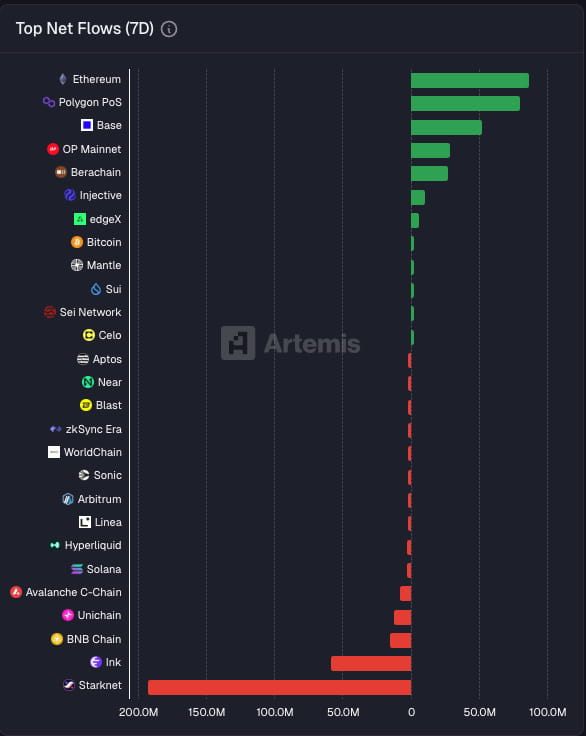
During January 12—18, 7-day Netflow data from Artemis suggests that the highest net inflows are on the Ethereum network at levels near $90 million, followed by Polygon PoS near $80 million and Base near $55 million, while OP Mainnet has a long inflow of $25 million and Berachain is around $20 million in cash inflows. Capital in these network clusters coincides with a recovering crypto market atmosphere, resulting in investors opting to gain weight in highly liquid networks with a wide range of DeFi ecosystems and practical applications.
On the other hand, the network with the highest net capital outflows is Starknet at a level close to $190 million, followed by Ink near $60 million, BNB Chain near $35 million, Unicchain near $25 million and Avalanche C-Chain near $20 million. The movement reflects the adjustment of the investor portfolio that has been losing weight in the network, whose activity on the chain is beginning to slow down. The period of January 12—18 significantly reflected the selection of networks, with funding flowing into platforms that were stronger in terms of liquidity and usability, rather than the networks from which the force was launched. Weakened
Fear & Greed Index

The Crypto Fear & Greed Index is one of the tools used to assess the outlook and sentiment of the crypto market, referring to scores ranging from 0 to 100 (0 stands for Extreme Fear or Extreme Fear and 100 stands for Extreme Greed).
During January 12—18, the Crypto Fear & Greed index moved from the Fear zone to around 25 on January 12-13, before rapidly climbing into the Greed zone near levels 60—62 on January 15. The move is consistent with the strong rise in Bitcoin price from the area near $90,000. Highs of $96,000—$97,000 over the same period, the overall picture reflects the market atmosphere shifting from cautious to short-term buoyancy, with investors becoming more exposed to risk from several consecutive days of buying forces.
After January 15, the index began to weaken from the Greed zone, returning to near the Neutral level on January 16—18, while Bitcoin prices began to slow down and entered a base rest in the $93,000—94,000 area, reflecting the behavior of some investors who took short-term gains as sentiment levels rose. The period of January 12—18 is therefore a vivid example of the relationship between market sentiment and price movement. That is, when fear subsides and greed increases, prices often accelerate sharply, and when confidence begins to saturate, the market enters a period of deceleration or adjustment according to the cycle of investor sentiment.
Bitcoin ETF Flow

The flow of capital in the Bitcoin ETF has been quite clear, reflecting a “pause in the chase,” with data from Farside Investors stating that on January 12, there was a total net inflow of +$116.7 million, before accelerating on January 13 at +$753.8 million and peaking this range on January 14 at +840.6 million. The dollar, the main driving force came from large funds, in particular IBIT (BlackRock), which had inflows of +70.7/+126.3/+648.4 million dollars on January 12, 13 and 14, respectively, as well as FBTC (Fidelity) inflows of +111.7/+351.4/+125.4 million dollars, in line with the mid-term crypto market conditions. A week of strong gains in prices and sentiment rebounded, institutional investors significantly increased their investment weight through ETFs.
HOWEVER, THE MOMENTUM BEGAN TO SLOW DOWN IMMEDIATELY, WITH ON JANUARY 15, TOTAL NET INFLOWS DROPPED TO +$100.0 MILLION. EVEN THOUGH IBIT STILL HAD INFLOWS OF +$315.8 MILLION, IT WAS REVERSED BY FBTC OUTFLOWS OF -$188.9 MILLION, AS WELL AS ADDITIONAL OUTFLOWS FROM SOME FUNDS, MAKING THE OVERALL PICTURE UNABLE TO MOVE FORWARD CONTINUOUSLY, AND ON THE 16TH. January, the situation flipped to a total net outflow of -394.7 million dollars, with FBTC outflows of -205.2 million dollars, while IBIT inflows of only +15.1 million dollars, reflecting profitable behavior and reducing short-term risks after two consecutive days of strong capital inflows. On January 17—18, the US ETF markets did not report new daily figures due to the weekend. As a result, the overview of the period reflected the pattern of “accelerated buying during the bullish period, before resting the base with a profitable selling force,” which is in line with the capital behavior of institutional investors this week.
Ethereum ETF Flow
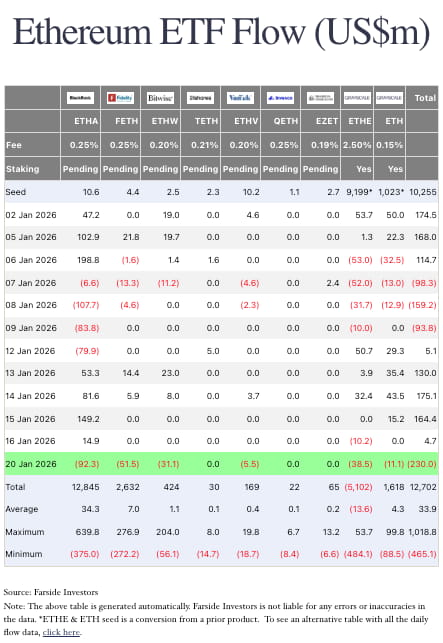
The movement of funds in the Ethereum ETF clearly reflects the market fluctuating in line with the rhythm of investor sentiment. On January 12, there was only a net inflow of the entire system of about $5.1 million, before accelerating sharply on January 14, to around $175.1 million, and also stabilizing at a high level on January 15. Around $164.4 million, the main driving force came from large funds like BlackRock (ETHA), which had inflows on January 14 and 15, reaching $81.6 and $149.2 million, respectively, in line with a range where Bitcoin prices and the crypto market as a whole rallied in the middle of the week, resulting in a lull. Institutional investment returns to significantly increase the weight of investments in digital assets through ETFs
Momentum, however, began to slow on January 16, when system-wide net inflows fell to around $4.7 million, while some funds began to have outflows, such as Fidelity and some smaller funds, mirroring short-term profit-taking behavior after strong inflows in the previous two days, the January 12-18 period, thus mirroring a market picture that “It's hot for periods” with capital accelerating as prices rise and sentiment recovers, but it's poised to slow as speculation begins to saturate. It shows that the Ethereum ETF during this period is also driven by market sentiment and price momentum, rather than a steady long-term hold of. Institutional Investor
Important news:
Source:
https://www.theblock.co/data/on-chain-metrics/ethereum
https://dune.com/starknet_foundation/starknet-activity
https://coinmarketcap.com/currencies/bitcoin/
Note: This analysis is provided every Monday, so some articles may have data discrepancies.
Nota: Questo analisi è situato ogni monday, quindi alcuni parti del articolo possono contengono informazioni inaccurati
WARNING: CRYPTOCURRENCIES AND DIGITAL TOKENS ARE HIGHLY RISKY. YOU MAY LOSE YOUR ENTIRE INVESTMENT. PLEASE STUDY AND INVEST ACCORDING TO THE ACCEPTABLE LEVEL OF RISK.
Thank you for following.
J.P. Daniel
News Cryptocurrency
_progressive.jpg)
_progressive.jpg)
_progressive.jpg)
Download the application Maxbit is available at


Securely register with a digital asset trading platform regulated by Thailand’s SEC.


Maxbit Digital Asset Co., Ltd., 90 CW Tower, 31st Floor, Room A3101-02, Ratchadaphisek Road, Huai Khwang Subdistrict, Huai Khwang District, Bangkok 10310, Thailand.
©2025 Maxbit. All Rights Reserved.


