

Weekly Research Recap 5 - 11 Jan 2026
Week of January 5 - 11, 2026
%20(1)_progressive.jpg)
Weekly Recap Research
Standard Chartered points out 2026 is the “year of Ethereum,” given its primary structural role in the crypto economy.

Standard Chartered sees 2026 as the “year of Ethereum” not due to expectations of a sharp rise in prices in the short term, but as a result of Ethereum's clear structural role in the crypto ecosystem. The network is the hub of stablecoin, DeFi and real asset-to-token conversion (RWA), along with a steady increase in transaction volume and real-world applications. With network upgrades that improve support performance, and if legislation such as the CLARITY Act in the US is considered, it will directly support activities on the Ethereum network.
On the price front, Standard Chartered estimates that ETH by the end of 2026 will be around $7,500, a level lower than previously estimated. However, the key point of such a view is not in price figures alone, but in Ethereum's potential to “generate returns above Bitcoin” in proportion to price and expansion of on-chain activity, while Bitcoin remains solid. Robust in its role as a value storage asset, Ethereum is evolving into the core infrastructure of the digital economy, making 2026 perhaps the time when that role becomes even more pronounced.
Strategy bought another 13,627 BTC in the first week of 2026, the most since July.

Strategie Inc. Announced on January 12, 2026, that the company acquired 13,627 BTC worth of Bitcoin between January 5—11, with an investment value of approximately US$1.25 billion. This acquisition is not a small increase in portfolios, but represents the largest weekly purchase since July 2025, reflecting that the company's strategy continues to adhere to policy guidelines. Accumulate Bitcoin seriously, even if market conditions remain volatile, and the price has not returned to test its original highs.
As a result of this acquisition, Strategy's Bitcoin holdings have increased to approximately 687,410 BTC, accounting for almost 3% of the total Bitcoin supply worldwide. The average price of this round of purchases is around $91,519 per BTC, which is higher than the company's original average cost. This reflects that the decision is not just a holding to await a short-term rise in price, but a confirmation of the angle. The strategic view is that increasing the proportion of Bitcoin on the balance sheet remains in line with the company's long-term asset management direction.
Top Net flows

Between January 5—11, the crypto market opened the year with a “risky” atmosphere before gradually switching to a cautious mid-week mode. Data from Artemis's 7-day Top Net Flows chart indicated that the money pellet was not flowing out of the system, but a shift in liquidity was taking place over Arbitrum, the chain receiving the highest inflows, followed by another L2 Ink., Base and Starknet, while Ethereum on the L1 side returned to the highest net cash outflows. The image echoes the market's original behavior, that when sentiment returns, users will move money from high-fee L1 to lower-cost L2, faster, and with more DeFi activity space. This is not an escape from the crypto market, but a “lane change” to optimize capital.
In the middle of the week, when market volatility increased and sales forces began to shift sharply, the bullion began to flow out of high-risk areas, especially leveraged line platforms such as Hyperliquid, which appeared negative numbers on the same graph, reflecting risk-reduction behavior and a slowdown in the use of leverage by investors. At the same time, some funds. The segment still chooses to rest on large L2 networks like Arbitrum and Base, which have high mobility and low transaction costs. So this week's overview is not a sign of a pullback from the market in a bearish manner, but rather a “spin” in line with market conditions from a proactive mode at the beginning of the week. To the cautious mode at the end, with players remaining in the system, only to choose the investment area that suits the more rhythm.
Fear & Greed Index

The Crypto Fear & Greed Index is one of the tools used to assess the outlook and sentiment of the crypto market, referring to scores ranging from 0 to 100 (0 stands for Extreme Fear or Extreme Fear and 100 stands for Extreme Greed).
During January 5—6, the Crypto Fear & Greed index rose significantly from around 30 points in the Neutral—Fear zone, moving up to around 43—45 points or the Greed zone on January 6. The move reflected the positive market atmosphere at the beginning of the year after the continued recovery in the price of digital assets, investors began to open. Taking more risks and anticipating the direction of the market in the next period. The increase of the index by more than 10—15 points within a few days indicates a rapid transition of market sentiment from cautious to positive sentiment.
Since January 7, the confidence index began to weaken steadily, from around 40+ points, dropping to near 30 points on January 8, and continuing to near 25 points (Fear level) during January 10—11. A drop of about 15—20 points within 4—5 days reflects that confidence has been replaced with caution. Investors began to focus on controlling risks rather than chasing profits. After crypto prices fluctuated and began to weaken, the January 5—11 overview thus clearly pointed to the transition from “positive expectation” to “risk cautious” in a short period of time, reflecting the characteristics of the sensitive crypto market. High investor sentiment
Bitcoin ETF Flow
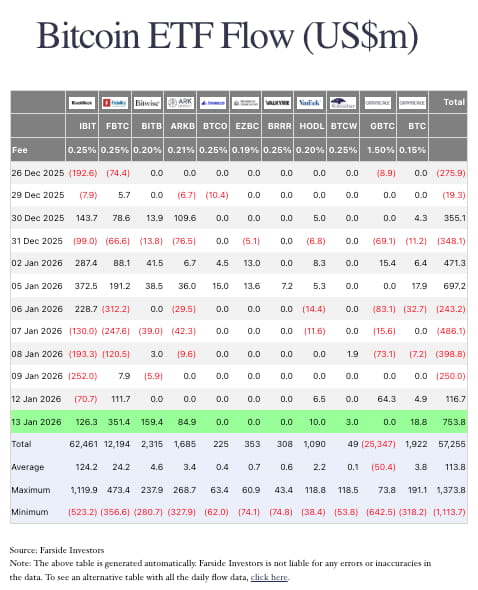
Between January 5—11, 2026, Bitcoin ETF cash flows clearly reflected market volatility. On January 5, there was a net inflow balance of +$697.2 million, led by IBIT (+$372.5 million) and FBTC (+$191.2 million), indicating investor confidence in the Bitcoin price direction, but since On January 6, a net selling force of -243.2 million began, before intensifying to -486.1 million on January 7. The simultaneous sell-off of IBIT (-130.0 million dollars), FBTC (-247.6 million dollars) and ARKB (-42.3 million dollars) reflects that the market is rapidly reducing risk after facing high volatility. Point out That the cash flow in a Bitcoin ETF is determined by the reaction to short-term volatility. Investors use ETFs as a tool to adjust their portfolios and reflect a strategic point of view rather than a long-term decision.
In early 2026, capital flows in the Ethereum ETF continued to be tight, with a net outflow of -398.8 million dollars on January 8 and a continuous outflow of -250.0 million dollars on January 9, before the end of the week began to see signs of a slight recovery at +116.7 million dollars on 12 January and again intensifying inflows. At $753.8 million on Jan. 13, the outlook reflects a “buoyant to cautious” nature. Institutional investors use ETFs to rapidly adjust portfolios in line with market sentiment, reflecting that the crypto market in this period is still sensitive to news, prices and short-term expectations, rather than a steady uptrend.
Ethereum ETF Flow
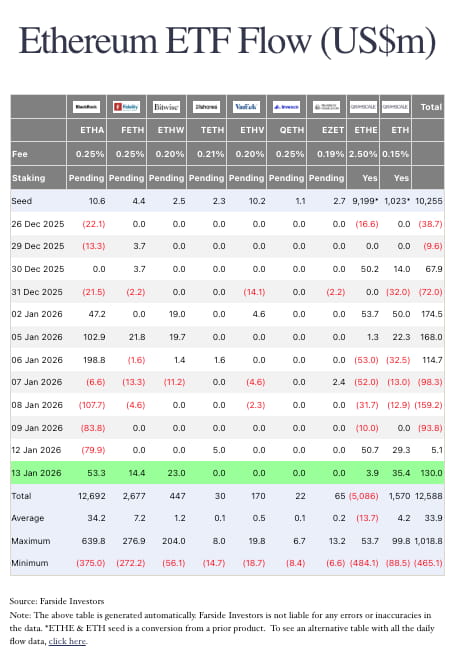
During the period 5—11 January 2026, the cash flow in the Ethereum ETF showed high volatility and rapid adjustment of the investor's portfolio. On January 5, there was a net inflow of about +168.0 million dollars, with ETHE inflows of about +53.7 million dollars and ETH +22.3 million dollars, reflecting that the market remained exposed to risk due to the beginning of the year, however, on January 6. Despite some stocks such as ETFA's having a long inflow of +$198.8 million, the sell-off in several piles led to a net drop to +$114.7 million, before the direction changed to a clear negative on Jan. 7, with net outflows of about $98.3 million, driven by concurrent sell-offs in Several piles, such as FETH -$13.3 million, ETHE -52.0 million, and ETH -13.0 million, reflect portfolio balancing and institutional investor caution during the first week of the new year.
The sell-off in the Ethereum ETF market continued on January 8, with a net outflow of around -$159.2 million, followed by January 9, another outflow of -93.8 million dollars, reflecting that investors began to seriously reduce risk. After the price volatility and the market atmosphere changed to cautious, the period from January 5—11 was therefore The period in which the Ethereum ETF shows a shift from an “inflow” state at the beginning of the week to a “outflow” state in the middle to the end of the week shows that institutional investors use ETFs as an important tool to quickly adjust their investment weight based on market sentiment, which remains more sensitive to short-term volatility than to long-term movements that unequivocal
Important news:
South Korea's KB Announces Patented Stablecoin Prepared to Expand Digital Financial Services
Russia passes final crypto bill, strengthens entire digital asset regulatory framework
Source:
https://dappradar.com/chain/base
https://dappradar.com/chain/arbitrum
Note: This analysis is provided every Monday, so some articles may have data discrepancies.
Nota: Questo analisi è situato ogni monday, quindi alcuni parti del articolo possono contengono informazioni inaccurati
WARNING: CRYPTOCURRENCIES AND DIGITAL TOKENS ARE HIGHLY RISKY. YOU MAY LOSE YOUR ENTIRE INVESTMENT. PLEASE STUDY AND INVEST ACCORDING TO THE ACCEPTABLE LEVEL OF RISK.
Thank you for following.
J.P. Daniel
News Cryptocurrency
_progressive.jpg)
_progressive.jpg)
_progressive.jpg)
Download the application Maxbit is available at


Securely register with a digital asset trading platform regulated by Thailand’s SEC.


Maxbit Digital Asset Co., Ltd., 90 CW Tower, 31st Floor, Room A3101-02, Ratchadaphisek Road, Huai Khwang Subdistrict, Huai Khwang District, Bangkok 10310, Thailand.
©2025 Maxbit. All Rights Reserved.


