

Weekly Recap Research 02 - 08 Feb 2026
Week of February 02 - 08, 2026
_progressive.jpg)
Weekly Recap Research
JPMorgan Set for Long-Term Bitcoin Hitting $266,000 'Above Gold' Despite Short-Term Market Weakness

JPMorgan assesses Bitcoin's long-term outlook by placing the price at $266,000 per BTC compared to the private sector's investment in gold at around $8 trillion, reflecting the analyst team's view that Bitcoin is more attractive than gold in terms of risk-to-return ratio, even as crypto prices remain weak in the short term. Bitcoin's volatility relative to gold has decreased to about 1.5 times, which is considered a record low. As a result, Bitcoin's investment profile has begun to become more similar to traditional hedging assets.
JPMorgan analysts also stated that the price target is based on the assumption that Bitcoin needs to expand its market value several times to match private investors' gold holdings, reiterating that a price target of $266,000 is not a short-term target this year and is also based on a recovery in market sentiment, as well as macroeconomic factors overall, as Bitcoin's current price continues to move. The turmoil is below the mine's average production cost of about $87,000, and there is still some sell-off from ETFs, making an adjustment to that target level seen as more of a long-term trend than in the near term.
Bitwise sees Bitcoin near sell-off after its biggest price drop in more than two years

Matt Hougan, chief investment officer (CIO) of Bitwise, sees Bitcoin's recent rapid decline, the biggest drop in two weeks since June 2022, driven primarily by technical selling and macro-factor pressures, rather than a systemic failure as in the past, with Bitcoin prices falling more than 50% from October highs. It fell to lows of around $60,000—$70,000 amid a sell-off from long-term investors and the forced closure of leveraged positions, reflecting pressure from a more risk-averse investment climate.
Hougan also noted that “a lot of bad news has already been reflected in prices,” allowing the market to approach the point of “exhaustion” or a period when the selling force begins to weaken, and could be an early sign of a bearish adjustment destination. Even if overall pressures such as risk reduction in risk assets and macroeconomic conditions remain. He also stressed that growth in fundamentals remains. In the crypto market, whether it's institutional acceptance or regulatory clarity, it could become a major support force as the market direction begins to recover in the next phase.
Top Net flows

Between February 2—8, 2026, capital flows in the crypto market reflected a major turnaround, with the last seven days of Net Flow data indicating that Ethereum had a net inflow of about $1.2 billion, considered the highest in weeks, reflecting a repurchase after the market went through a period of consolidation, while secondary networks like Injective had an inflow of 25—30 million. Dollar, Ink, about $20 million, and Unicchain, about $15 million, represent the beginning of a recovery in activity in some ecosystems after the sales force begins to unravel.
In contrast, funds continue to flow out of some networks, notably Arbitrum with a maximum outflow of around $1.1 billion, as well as Hyperliquid with an additional outflow of around $120—150 million. Reflecting the migration of liquidity from the Layer-2 platform and some DeFi back to the main network, so the overall picture of the week is not an outflow from the crypto market as a whole, but a Balance capital to look for opportunities in assets or networks with potential recovery in the next round.
Fear & Greed Index
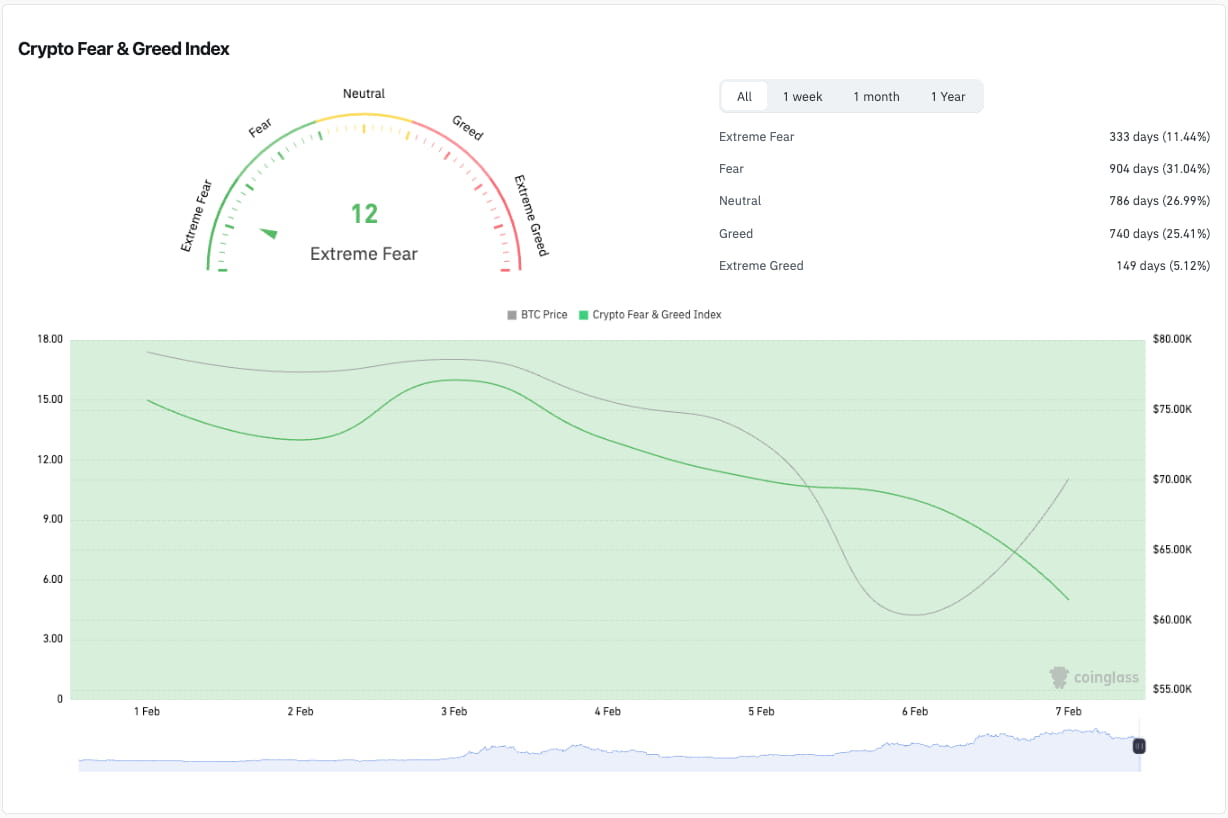
The Crypto Fear & Greed Index is one of the tools used to assess the outlook and sentiment of the crypto market, referring to scores ranging from 0 to 100 (0 stands for Extreme Fear or Extreme Fear and 100 stands for Extreme Greed).
The investment atmosphere in the crypto market remains in a state of concern, with the Crypto Fear & Greed Index moving in the Extreme Fear zone and dropping to about 12 points in the same week, in line with the fall in the price of Bitcoin from around $76,000—77,000 at the beginning of the week, to a low near $60,000—62,000 sent on February 6. As a result, most investors choose to adjust their risk and delay the opening of new positions.
However, after hitting the low, the market began to see buying power back in, with Bitcoin price recovering to move in the $68,000—70,000 range late in the week (February 7—8) as the sentiment index began to stabilize, despite remaining in the Extreme Fear zone. The overall picture reflects that the market is in a rebound after heavy selling and still needs to follow the direction of the trend. Will the funds continue to return to the market next week?
Bitcoin ETF Flow

Cash flow in the Bitcoin Spot ETF began to show more signs of volatility despite periodic rebound of buying power. On February 2, there was a net inflow of about $561.8 million, a recovery after the previous month facing continued selling. However, the sell-off again pushed the market again on February 3 with a net outflow of about $272 million. R, and rose to about $544.9 million on Feb. 4, reflecting that institutional investors continued to adjust portfolios to mitigate risk amid Bitcoin price volatility.
The sell-off continued on February 5, with outflows reaching around $434.1 million, before the market began to see buying back at the end of the week. On February 6, there was a net inflow of around $371.1 million, making the overall picture of the week a swinging in—out movement, reflecting that the market is in a period where the buying force for accumulation and the selling force to mitigate risk remains. Struggling closely as investors continue to wait for more clear market direction over the coming February period.
Ethereum ETF Flow

The Ethereum Spot ETF continues to reflect the volatile market conditions, with a net outflow of about $2.9 million on February 2, before a clear increase in sales force on February 4, with an outflow of about $79.4 million and continuing on February 5 at around $80.8 million. The picture reflects that institutional investors. Bun continues to reduce investment risk amid the volatility of overall digital assets during the period.
However, the end of the week began to see signs of buying back, with a net inflow balance of around $16.7 million on February 6 and continuing on February 9 with net inflows of around $57 million, reflecting a partial rebound in accumulation after the price weakened. The overall picture suggests that the Ethereum ETF market is still in a correction phase with the beginning of its existence. Accumulating forces are returning, even as investors continue to exercise caution and await the clarity of the market direction in the next phase.
Important news:
Uniswap invades ETF market after Bitwise files listing with SEC
Russia's largest bank prepares to issue loans using crypto as collateral
Source:
https://www.theblock.co/data/etfs/bitcoin-etf/spot-bitcoin-etf-flows
https://www.coinglass.com/etf/ethereum
https://cryptoquant.com/asset/eth/chart/exchange-flows
Note: This analysis is provided every Monday, so some articles may have data discrepancies.
Nota: Questo analisi è situato ogni monday, quindi alcuni parti del articolo possono contengono informazioni inaccurati
WARNING: CRYPTOCURRENCIES AND DIGITAL TOKENS ARE HIGHLY RISKY. YOU MAY LOSE YOUR ENTIRE INVESTMENT. PLEASE STUDY AND INVEST ACCORDING TO THE ACCEPTABLE LEVEL OF RISK.
Thank you for following.
J.P. Daniel
News Cryptocurrency
_progressive.jpg)
_progressive.jpg)
_progressive.jpg)
Download the application Maxbit is available at


Securely register with a digital asset trading platform regulated by Thailand’s SEC.


Maxbit Digital Asset Co., Ltd., 90 CW Tower, 31st Floor, Room A3101-02, Ratchadaphisek Road, Huai Khwang Subdistrict, Huai Khwang District, Bangkok 10310, Thailand.
©2025 Maxbit. All Rights Reserved.


