

Bitcoin was originally created by Satoshi Nakamoto to bypass control from intermediaries. Today, it is widely recognized by both individuals and institutions as a store of value.Comparing asset accumulation between Bitcoin and gold using a DCA strategy of 1,000 THB per month from September 26, 2020, to September 26, 2025 (5 years), the total returns show that Bitcoin’s 1-year ROI was lower than gold’s (16.01% vs. 23.55%). However, over the medium to long term, Bitcoin’s ROI significantly outpaced gold, reaching 1–2 times higher.Investor confidence in Bitcoin is also driven by its fixed supply of 21 million coins, with new coins issued through mining being halved every 4 years. In contrast, gold supply reflects ongoing increases in production, giving it characteristics more similar to fiat money. This makes Bitcoin a clearly deflationary, high-growth store of value, while gold remains a more stable, defensive asset.
Compare the stability and market swings of Gold and Bitcoin.
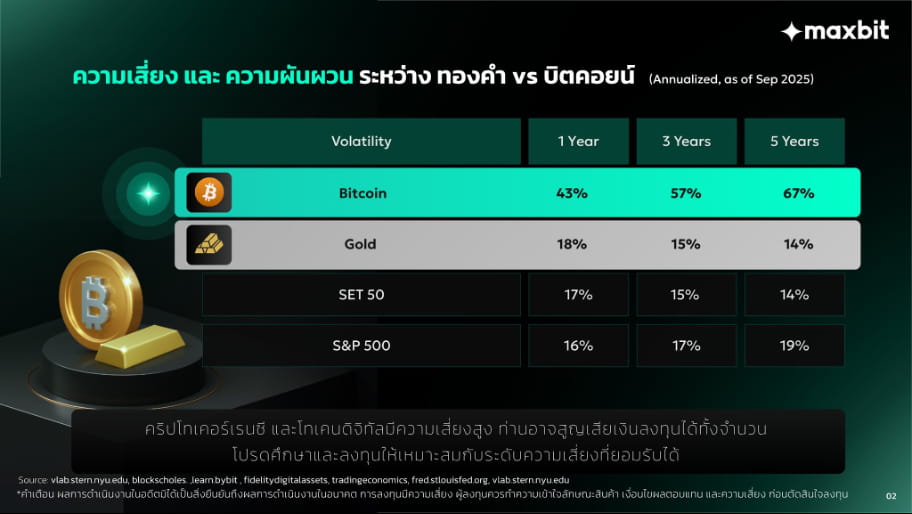
As mentioned earlier, gold’s lower volatility makes it a classic defensive asset, with average fluctuations decreasing over time. In contrast, Bitcoin experiences higher volatility due to growing interest from individuals and institutional investors, as well as macroeconomic influences worldwide.While gold is more stable and primarily serves as a safe-haven asset, Bitcoin’s higher volatility reflects the growth structure of a digital asset that is still gaining global adoption. From retail users to institutional investors, and through financial instruments like Spot ETFs, Bitcoin’s liquidity and investor base continue to expand significantly.Combined with its limited and transparent supply and the halving cycle that reduces new coins every four years, Bitcoin prices respond faster to market demand than traditional assets. Volatility becomes part of the price formation process and is a key reason why Bitcoin often experiences stronger recoveries when markets turn positive.Structurally, gold’s low volatility is ideal for preserving value, while Bitcoin’s higher volatility—though requiring proper risk management—offers greater growth potential over time, particularly for long-term holders and DCA investors.
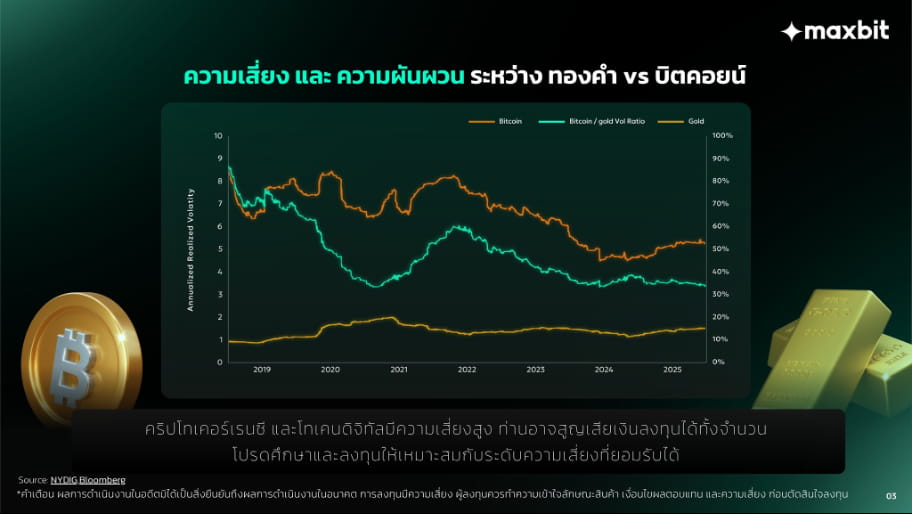
From the graph above, it can be seen that Bitcoin’s volatility has gradually decreased compared to its early days, reflecting market growth and increased liquidity in global trading. As more users and institutions enter the market, Bitcoin’s price movements have become more systematic.Although still more volatile than gold, this reduced fluctuation indicates the development and growing acceptance of digital assets as a modern store of value. In contrast, gold’s stable price and widespread industrial use make it a reliable safe-haven asset.Meanwhile, Bitcoin, still in a growth phase, responds more quickly to economic cycles and investment trends than traditional assets. This responsiveness allows its price to reflect market sentiment clearly and enables stronger recoveries during positive cycles.Over the medium to long term, Bitcoin’s higher volatility, while requiring proper risk management, drives greater growth potential compared to slower-moving assets. Many investors view this as a structural advantage of modern digital assets.
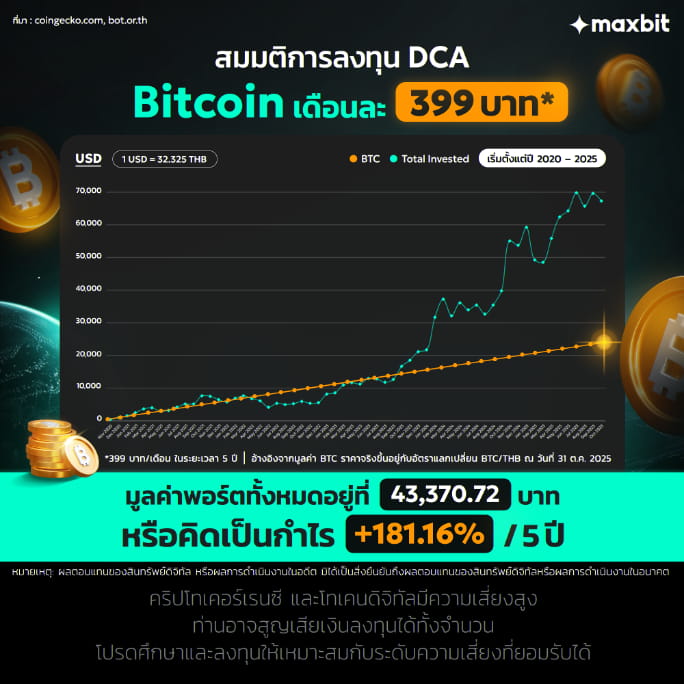
At Maxbit, a simulated DCA investment in Bitcoin of 399 THB per month over the past five years (2020–2025) with a total principal of 23,940 THB would result in a portfolio value of 43,370.72 THB, representing a gain of +181.16% over five years.Dollar-Cost Averaging (DCA) is a strategy that helps manage market volatility by investing a fixed amount each month, focusing on long-term asset accumulation. This approach allows investors to steadily grow their holdings without worrying about timing the market.However, the performance of digital assets like Bitcoin can vary depending on the investment period and market conditions. Investment decisions should always consider your risk tolerance and financial goals carefully.
Past performance of digital assets does not guarantee future returns.
Maxbit Digital Asset Co., Ltd., 90 CW Tower, 31st Floor, Room A3101-02, Ratchadaphisek Road, Huai Khwang Subdistrict, Huai Khwang District, Bangkok 10310, Thailand.
©2025 Maxbit. All Rights Reserved.


